
Safeguarding
At Graveney Primary School, safeguarding and promoting the welfare of every child is our highest priority. We are committed to providing a safe, caring environment in which children feel listened to, valued and confident about asking for help. Safeguarding is everyone’s responsibility, and all concerns are taken seriously.
Safeguarding concern about a child
If you are worried about the safety or welfare of a child, please contact Mrs Rogers or one of the Deputy DSLs by calling the school office on 01795 532 005 or email Headteacher@graveney.kent.sch.uk
If a child is in immediate danger, call 999.
You can contact Kent Children’s Services on 03000 41 11 11 or email social.services@kent.gov.uk.
Outside normal office hours, call 03000 41 91 91.
Report child abuse - Kent County Council
Safeguarding concern about an adult
If you have a safeguarding concern about the behaviour of an adult working or volunteering at the school, please report it immediately to the Headteacher.
If the concern is about the Headteacher, it should be reported to the Chair of Governors through the school office.
Concerns will be managed in accordance with statutory safeguarding guidance and Kent’s Local Authority Designated Officer procedures.
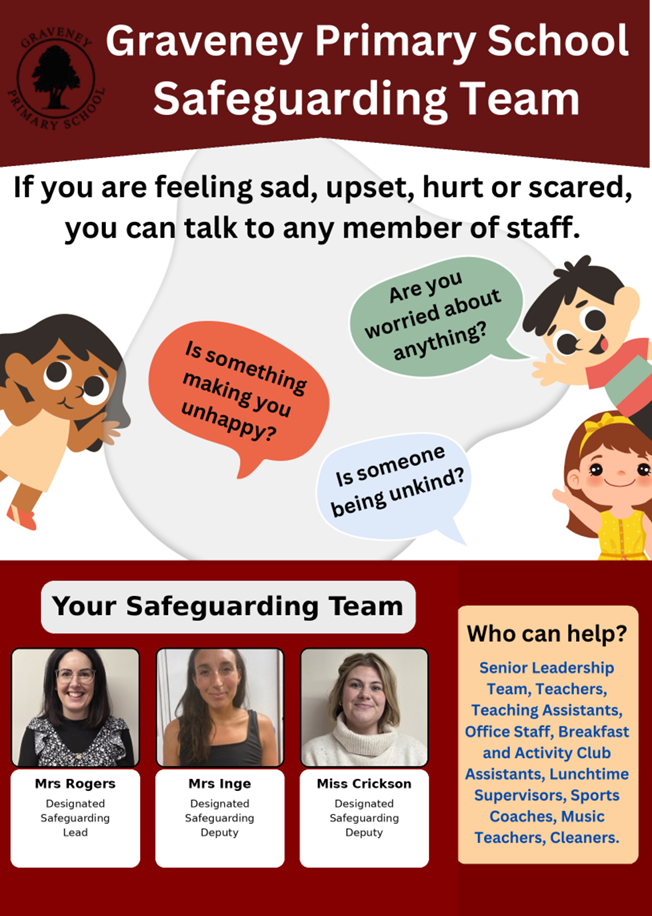
Meet the safeguarding team
Online Safety information for parents and carers
Below are resources that parents and carers can look at to ensure that children are safer online. These resources highlight some of the latest apps and sites that children use, and have helpful information about privacy and safety settings. Remember, it is difficult to ensure that children are kept safe online, if those responsible for their safety don’t understand the potential risks. If you have concerns about online grooming or exploitation, report to CEOP immediately: www.ceop.police.uk/Ceop-Report
|
Think U Know: www.thinkuknow.co.uk The Child exploitation and Online Protection Centre (CEOP) has a website which is suitable for children aged 5-15 and has a section just for parents/carers with advice and information. |
|
NSPCC: www.net-aware.org.uk and www.nspcc.org.uk/onlinesafety The NSPCC has produced resources for parents, including Net Aware, a tool which reviews some of the most popular apps. The website provides excellent advice for parents about issues such as online rooming, “sexting” and cyberbullying. They also provide a helpline for parents over the phone: 0808 8005002 |
|
Childline: www.childline.org.uk The childline website has a wide range of information and advice on both online and offline safety. There is information about online gaming, grooming, and the Zipit App, which helps children feel empowered when confronted with inappropriate chat online. They also provide a helpline for children to get advice over the phone: 0800 1111 |
|
UK Safer Internet Centre: www.saferinternet.org.uk UK Safer Internet Centre provides a wide variety of advice and guidance to help you discuss online safety with your children. There are useful checklists for privacy settings on social networks and suggestions to consider before buying devices for your children. |
|
Childnet: www.childnet.com Childnet has resources, including videos and storybooks, to help you discuss online safety with your children. It includes advice on setting up parental controls, cyberbullying and setting up a family agreement for safer internet use. |
|
Parent Info: www.parentinfo.org Parent Info provides information to parents and carers about a wide range of subject matter, from difficult topics about sex, relationships and the internet or body image and peer pressure to broader parenting topics such as “how much sleep do teenagers need?” |
|
BBC Stay Safe: www.bbc.co.uk/cbbc.curations/stay-safe This is the BBC’s ‘ultimate internet survival guide’ designed for children. It contains tips and tricks they’ll need to stay safe online, beat the cyberbullies and be a ‘super-surfer’. |
NOS Newsletters
- 12 Online Safety tips for Christmas.pdf
- 10 Top Tips for Remote Education.pdf
- What parents need to know about Microsoft Teams.pdf
- 7 Top Tips for Supporting Children to Express Themselves Safely Online